

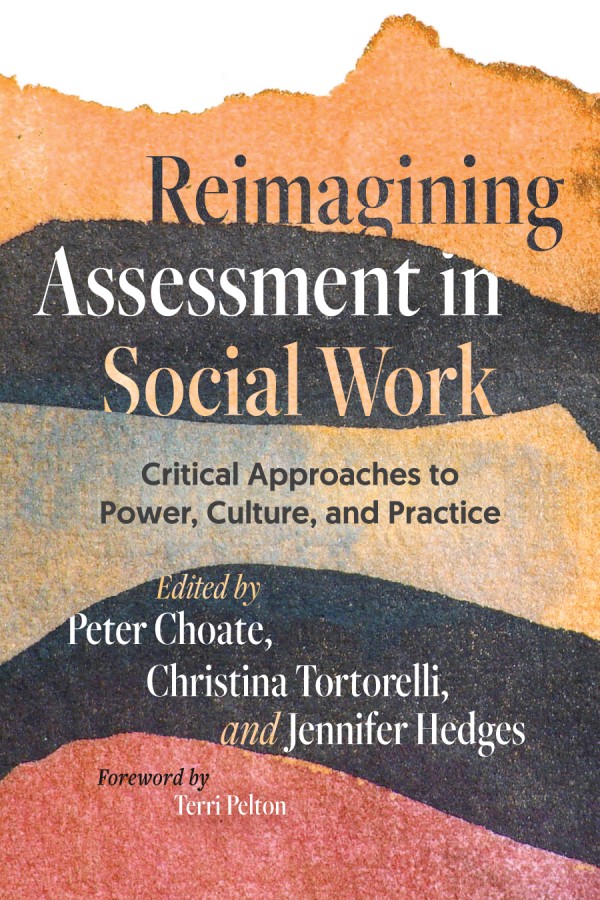
Reimagining Assessment in Social Work
Critical Approaches to Power, Culture, and Practice
Social work assessment is political. How we understand its power is at the heart of ethical social work practice.
About the book
Assessment is everywhere in social work. Done well, assessment advances the social worker's understanding of clients’ contexts and creates pathways for supporting their lives. Done poorly, colonialism and power take over the story, sustaining marginalization, disempowerment, and damaging outcomes.
This book considers the many ways assessment carries power, from the way information is reported, collected, and acted upon through to the clients’ interactions with adjacent systems and institutions. Authors in this volume tackle the troubled history of racist and Eurocentric assessment and engage critically with issues of colonialism, assumptions about the meaning of family, anti-Black racism, disability and neurodivergence, migration and citizenship, restorative justice and aging out of care. Focusing on pragmatic skills rooted in theory and connected to major social issues, this collection is an indispensable resource for social work students and practitioners learning to ground assessment in relational collaboration, reflexivity, and critical thinking.
With contributions from: Dorothy Badry, Natalie Beltrano, Susan Burke, Victor Chikadzi, Peter Choate, Nancy Flatters, Jennifer Hedges, Leona Huntinghawk, Ashlee Homewood, Julie Mann-Johnson, Tammy Pearson, Desi Shebobman, Christina Tortorelli, Carol Wade and Ajwang' Warria.
Family Studies Indigenous Resistance & Decolonization Social Work
What people are saying
Donna Baines, Professor, UBC, editor of Doing Anti-Oppressive Practice: Rethinking Theory and Practice“A much-needed critical, decolonial, and anti-oppressive lens to the practice of assessment in child welfare. This very clear and compelling text should be required reading for all social work practitioners who long to advance social justice enacted within child welfare and allied fields.”
Kathleen E. Absolon (Minogiizhigokwe), author of Kaandossiwin: How We Come to Know Indigenous re-Search Methodologies“A great resource! This book is a very timely offering of rethinking social work assessments that are ethically responsible and culturally aligned with values of social and structural justice.”
Don Fuchs, Faculty of Social Work, University of Manitoba“A groundbreaking and deeply reflective contribution to the field of social work practice in child welfare, Reimagining Assessment in Social Work serves as an essential guide for moving beyond bureaucratic compliance toward a practice rooted in social justice and genuine human connection. By centering assessment as a curiosity-driven partnership, the authors challenge policymakers, practitioners, and students alike to resist colonial harms and standardized surveillance in favour of ethically accountable, culturally grounded, social justice-oriented practice with children and families.”
Ian Hyslop, University of Auckland, New Zealand“From a variety of perspectives, contributors interrogate this fraught area of practice – how and why are assessments made and which voices are overtly and covertly privileged in the process? This book destabilizes narrative assumptions and invites students and teachers of social work to grapple with questions vitally important if child welfare work is to develop its social justice aspirations.”
W. Ben Gibbard, Alberta Children’s Hospital and University of Calgary Cumming School of Medicine“This book expands the scope of assessment from safety and risk to encompass strengths and contextual supports identified through relational collaboration with families that promotes the resiliency of children, families, communities, and cultures. A timely and important book that challenges the reader to reconsider child welfare assessment from the perspective of the child and family.”
Authors



Contents
- Chapter 1: Assessment Is the Noun, Critical Thinking Is the Verb (Peter Choate, Christina Tortorelli, and Jennifer Hedges)
- Chapter 2: The Paradox of Assessment in Child Welfare Practice (Christina Tortorelli)
- Chapter 3: Bringing an Indigenous Lens to Assessment: The Example of Ani to Pisi (Roy Bear Chief and Peter Choate)
- Chapter 4: The Space Between Abolition and Now: Assessment in Child Welfare (Jennifer Hedges)
- Chapter 5: Indigenous Fathers: The Missing Voice in Child Welfare Assessment (Leona Huntinghawk)
- Chapter 6: House Hunting: Caregiver Assessment and Home Study Practice (Julie Mann-Johnson)
- Chapter 7: Wisdom from Families: Indigenous Kinship Caregivers’ Experiences with Home Approval Process (Susan Burke)
- Chapter 8: Deconstructing White Supremacy in Safety and Risk Assessments: Applying Critical Race Feminist Theory and Intersectionality as an Analytical Strategy for Transformation in Child Welfare (Natalie Beltrano and Carol Wade)
- Chapter 9: Critical Assessment with Black Immigrant and Newcomer Children: Lessons for Social Work and Social Service Practitioners in Canada (Ajwang Warria and Victor Chikadzi)
- Chapter 10: Practice Considerations for Parent Understanding (Tammy Pearson)
- Chapter 11: Social Work Ethics, Neurodiversity, Disability and Child Protection (Dorothy Badry and Yahya El-Lahib)
- Chapter 12: Assessment Goes to Court (Peter Choate)
- Chapter 13: An Overview of Restorative Justice and Career Inclusion (Nancy Flatters and D. Lindstrom)
- Chapter 14: Transitioning to Adulthood from Being in Care – A Lonely Journey (Ashlee Homewood and Christina Tortorelli)

_cover-FINAL_400_600_90_s.jpg)


_cover-FINAL_400_600_90_s.jpg)