
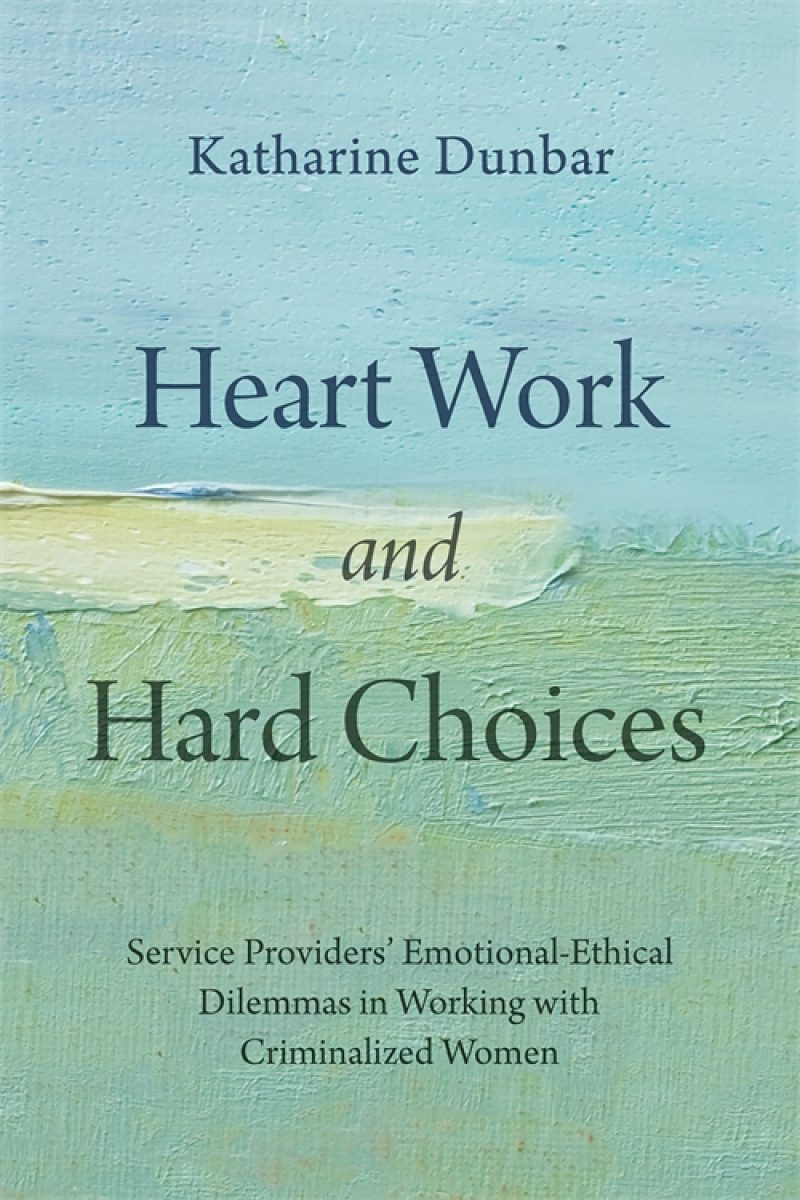
Heart Work and Hard Choices
Service Providers’ Emotional-Ethical Dilemmas in Working with Criminalized Women
A hopeful and critical study of how community-based service providers navigate emotional, ethical, and structural challenges in their work supporting criminalized women.
About the book
Heart Work and Hard Choices brilliantly tackles urgent debates around the interlocking crises of criminalization, social inequality, and care by drawing on the collective knowledge and experience of community service workers. Through vivid storytelling and grounded research, Katharine Dunbar draws on her experience in community service and formidable talents as a public sociologist to reveal how providers manage compassion, frustration, burnout, and hope in order to build and sustain relationships and remain effective in their roles. In taking an innovative sociology-of-emotions approach, Dunbar connects individual feelings to broader themes of neoliberal policy that shift responsibility for harm from the state onto marginalized women and the organizations that serve them. In centring emotions, the book exposes hidden forms of control and care, as well as the emotional and ethical dilemmas that arise when community organizations are asked to enact both support and surveillance. This book is a hopeful and critical look at what genuine support for community service provision should look like. This is essential reading for anyone seeking a practical and radical way forward for a sector in turmoil.
Class Inequality Crime & Law Feminism, Gender & Sexuality Public Policy Social Work Sociology
What people are saying
Elizabeth Comack, distinguished professor emerita, University of Manitoba“A significant contribution to feminist criminology, with relevance for both academics and practitioners who work with criminalized women.”
Catherine Bryan, School of Social Work, Dalhousie University“This important contribution to the scholarship offers vital insight into the challenges and barriers faced by criminalized women and the incredible effort of service providers in assisting their clients in navigating and overcoming those challenges and barriers.”
Author

Contents
- Chapter 1:: Walking the Line: Emotions and Boundaries for Service Providers
- Chapter 2:: Why Emotions Matter in Community Service Provision
- Chapter 3:: Boundaries and Care in Community Work
- Chapter 4:: Carrying Their Stories: Trauma, Loss, and Service Provision
- Chapter 5:: Managing Emotions in the Lives of Criminalized Women
- Chapter 6:: Systemic Barriers and Everyday Struggles
- Chapter 7: : Toward Systemic Change
- Appendix:: The Research Process: Feminist and Trauma Informed Methodology