
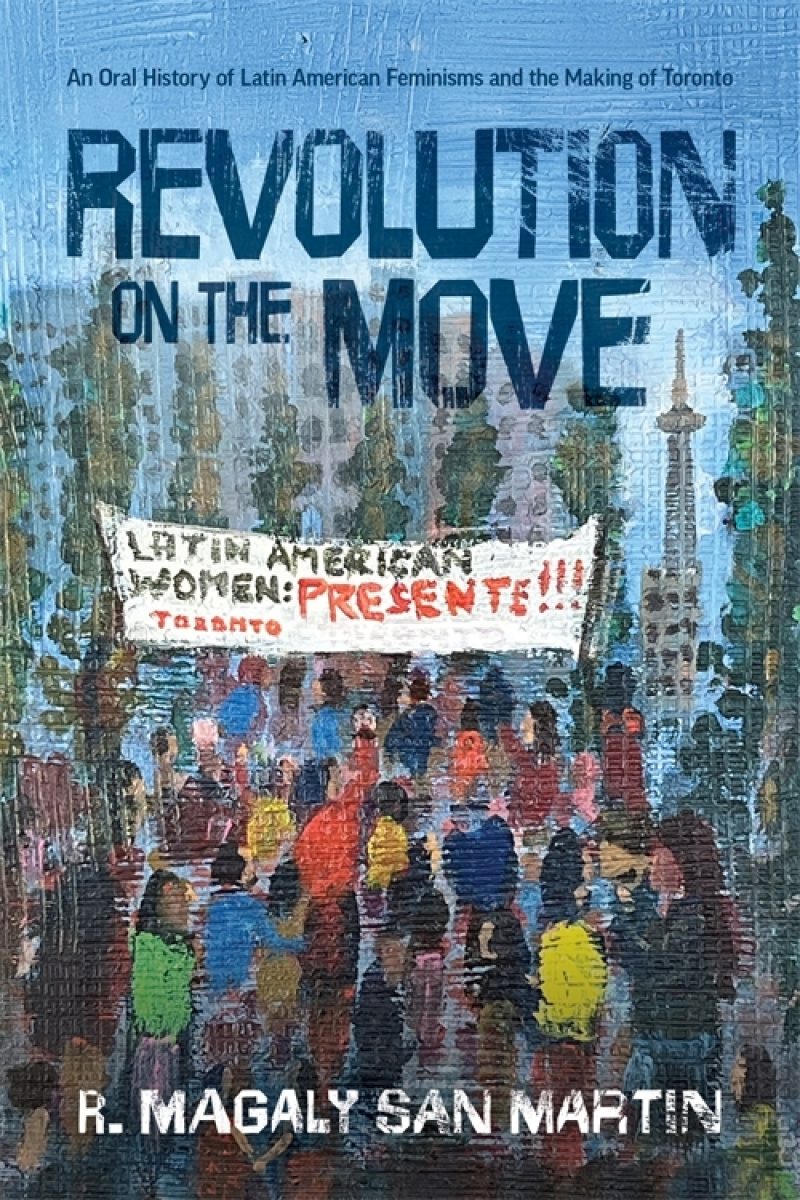
Revolution on the Move
An Oral History of Latin American Feminisms and the Making of Toronto
An oral history of grassroots activism that reclaims Latinas’ political contribution to Toronto, highlighting feminist agency, anti-oppression struggles, and social justice activism.
About the book
This book gathers the unforgettable voices of Latin American feminist activists who joined together to confront entrenched power and along the way transformed Canada’s biggest city. Based on decades of grassroots feminist activism and engaged scholarship, R. Magaly San Martin offers a sweeping and deeply affecting account of the pivotal role racialized immigrant feminists have played in Toronto’s legendary social justice struggles.
San Martin’s oral history upends dominant historiographies, revealing Latin American feminists' role in shaping Toronto's unique political and social milieu. Through a tapestry of voices, Revolution on the Move reveals how anti-oppression work evolved within the Latin American community. Neither linear nor devoid of contradictions, this dialogue across generations contributes to a unique and evolving Latina feminist subjectivity. Everyone interested in social justice, feminist politics, and Toronto’s singular political culture will find in the company of these extraordinary characters the courage and inspiration to transform our own time.
Feminism, Gender & Sexuality International Politics Activism & Social Movements Sociology Urban Studies
What people are saying
Joan Simalchik, professor emerita University of Toronto, Historical Studies Department"This work is a major contribution to research. Because of the author’s academic credentials and enhanced by her lived experience, its value lies in its original insight into the lives of the Latin American women themselves."
Vannina Sztainbok, professor emerita, University of Toronto, Ontario Institute for Studies in Education"This is a truly feminist book, which shows that all aspects of women’s organizing is political, from the empanadas they make for the peñas, to providing child-care, education, attending international conferences, agitating for legal intervention in spousal abuse cases, and organizing for the rights of prisoners back home. Additionally, the book centers an often overlooked history in English language feminist scholarship - the role of local and transnational feminist exchanges between Latin American women in their countries of origin and the diaspora."
Cynthia Wright, associate professor, Gender and Sexuality Studies, York University“The bold reclamation of feminist history and organizing we have been waiting for. Drawing on oral histories and her own multi-sited feminist activism, Magaly San Martin challenges the erasure of the extraordinary work of Latinx and Latin American left feminist organizers, community workers and thinkers. A must read for these monstrous times.”
Author

Contents
- Chapter 1:: Historical memories and Persistent Erasures
- Chapter 2:: Exile and the Bridge Called Solidarity
- Chapter 3:: Transnational Organizing and Feminist Consciousness
- Chapter 4:: Collective power – The Latin American Feminist Agency in Community Organizing
- Chapter 5:: Transnational Feminisms – The Encuentros
- Chapter 6:: “Rapists, Drug Pushers and Pimps”: Anti-Racism Organizing
- Chapter 7:: Cultivating Latina Leaders
- Chapter 8:: Latina Feminisms Unbound – The Latina Feminisms Course
- : Conclusion