
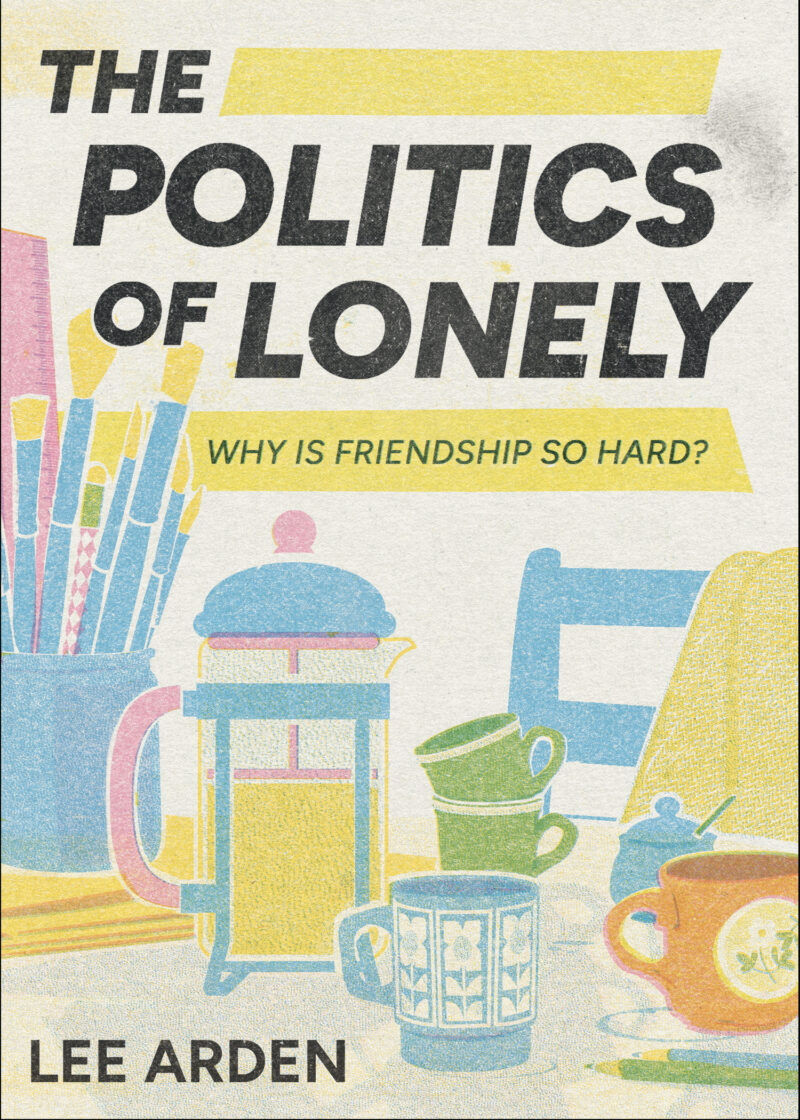
The Politics of Lonely
Why Is Friendship So Hard?
Friendship is hard because everything is hard. This book examines social structures to demonstrate how people mend an unravelling social fabric.
About the book
Why is it hard to make and keep friends as an adult? Even if you finally find time to see each other, can you connect more deeply than just catching up over coffee? How many do you count as ride-or-die pals who’ll always show up with effervescent banter and deep conversation — your “chosen family?”
Widespread loneliness reflects a world of crappy jobs and unaffordable housing that makes it almost impossible to have close, interwoven friendships. A dwindling social safety net takes a toll on us and on our relationships. Particularly for queer people, friendships can be crucial relations of equality, constancy, and care. Still, we disappoint each other and fall into irreparable conflict.
A less lonely world is possible. Through interviews, research, and personal narrative, this book shows how people build tight connections despite living in the austere conditions of colonial capitalism — boldly weaving a new social fabric as this one unravels.
Family Studies Feminism, Gender & Sexuality Capitalism & Alternatives
What people are saying
Alexis Shotwell, author of Against Purity: Living Ethically in Compromised Times“A friend-letter (which is like a love-letter, but more complicated) to the ordinary glory of being with others, in all our mess and beauty, The Politics of Lonely is an incisive call to build worlds in which friendship is more and more accessible, for everyone.”
Nora Loreto, author of The Social Safety Net“There are few things as mundane in our lives as friendship, but also, few things as important that are also as unprobed. What makes a friend? What do we need from others? How do our relationships buoy our happiness or exacerbate our loneliness? Lee Arden has given us a lot to think about in this radical examination of one of society’s most important social bonds.”
Mattilda Bernstein Sycamore, author of Terry Dactyl“The Politics of Lonely made me feel less lonely. Yes, this is a book that invokes the radical potential of queer friendship—all the dreams and aspirations—without neglecting to address the personal, intimate, and structural failures. Drawing from a wide variety of voices in literature, critical thinking—and, yes, friendship—this book moves us toward everyday intimacy, collaboration, mutual aid, protest, communal living, and an expansion of care networks to provide a safety net for everyone.”
Ardath Whynacht, author of Insurgent Love“Lee Arden offers a thoughtful meditation on what austerity has done to our friendships, with a pragmatic and radically grounded pathway to transform and rebuild a social safety net in the spaces between us.”
Cindy Barukh Milstein, editor of Constellations of Care: Anarcha-Feminism in Practice“Arden’s exploration of friendship as ‘the highest ideal of love’ is essential medicine for these dehumanizing times. It is neither bitter pill nor sugarcoated remedy for what ails our ability to make friendship live up to our aspirations. Instead, it is dreamily homeopathic, mixing up a tonic to strengthen our broken hearts. It is at once vulnerable and brave, messily honest and truly beautiful, deeply personal and systemically political, reminding us that friendship is ‘worth the struggle,’ as part and parcel of social transformation.”
Author

Contents
- Preface:: Friendship Is Worth the Struggle
- Part 1: : What Is Friendship?
- : Do We Even Know What Friendship Is?
- : Casual Sex, Serious Friendships, and Life Outside the Couple
- : Weaving Networks of Friendship
- : The Families We Choose
- Part 2: : Why Is Friendship So Hard?
- : The Ideology of Coupledom
- : Shredded Social Safety Nets
- : Lonely, Expensive Homes
- : Work, the Joy-Eater
- Part 3:: Towards a Friendlier World
- : Divesting from Whiteness
- : Investing in Shared Resources
- : Organizing Together
- : Planning Together
- : Learning How (and Why) to Repair
- : Building Community and Friendship across Difference
- : Returning to Ritual, Celebration, and Grief
- Conclusion:: Imagining a New World as This One Crumbles