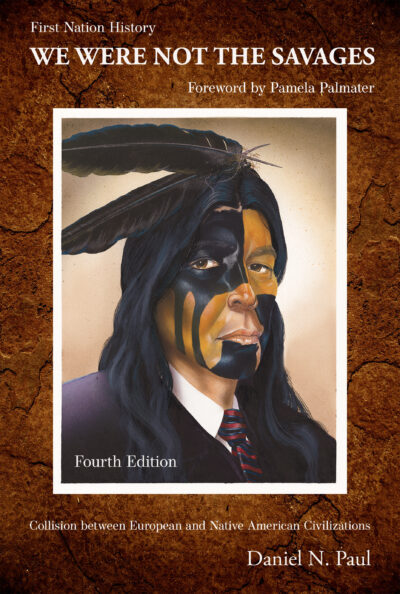

We Were Not The Savages, First Nations History, 3rd ed.
Collision between European and Native American Civilizations
This updated edition incorporates Daniel Paul’s ongoing research. It clearly and profoundly shows that the horrors of history still rain upon the First Nations people of the present.
About the book
“We Were Not the Savages … is unique, in chronological scope and in the story it tells, covering the last three centuries of Mi’kmaq history in detail. Prior to the appearance of this book it was common for historians to downplay or even deny the violence inflicted on the Mi’kmaq people by European and Euro-American colonizers. This work, more than any other piece of scholarly production, has headed off that consensus at a pass. Scalp-bounty policies are now recognized as a historical problem worthy of investigation.
The book will also be of particular interest to readers in the United States for a variety of reasons. First, the early history of colonization in the Maritimes is closely tied to the history of the colonies that became the United States, and as late as the 1750s New England’s political leaders played a prominent role in directing the course of colonial affairs on Cape Breton Island and Nova Scotia. … Second, the chapters on the nineteenth and twentieth centuries provide a detailed and much needed basis of comparison for anyone seeking to understand the similarities and contrasts between the U.S. and Canada on questions of “Indian Affairs.” And finally, it is important to recognize that we have far too few histories written by Native American authors—very few indeed that cover as extensive a time span as this book does.”
— Geoffrey Plank, Associate Professor of History, University of Cincinnati
“Having, over the years … read most of the sources you cite in your book, I had long ago arrived at the same conclusion you have. Certainly, white intrusions everywhere in the world have been disastrous for indigenous peoples.”
— Allison Mitcham, Professor Emeritus, University of Moncton
“Count me in too, among your book’s advocates… [it] knocks the smile off Englishmen who claim their colonial presence among Indians was ‘better’ than that of the Spanish.”
— C. Blue Clark, Interim Director, Native American Legal Center, Oklahoma City
“We Were Not the Savages is a provocative and excellent book…. It is brave, insightful, unflinching and above all honest. And, most important, it greatly enhances our positive images of Amerindians.”
— Barry Jean Ancelet, University of Louisiana
“Reading the pages of this book, continually affirms for me, how good it is to be a Mi’kmaq. I so wish that my father was still living. Wouldn’t he be so proud that such a book was available. I also wish that this history book was in existence years ago, a book that now empowers me and fills me with great pride to be a Mi’kmaq.”
— Sister Dorothy Moore, Prominent Mi’kmaq Educator
This updated edition incorporates Daniel Paul’s ongoing research. It clearly and profoundly shows that the horrors of history still rain upon the First Nations people of the present.
DANIEL PAUL is an ardent spokesperson and activist for human rights. He holds, among many awards, an honorary degree in Letters, Université Sainte-Anne, Church Point, Nova Scotia. He is a member of the Order of Canada and a member of the Order of Nova Scotia.
What people are saying
Reviewed by Tasha Hubbard for Canadian Literature
Savage/Civilized has been a stubborn binary in the realm of Indigenous-European history, with the term ‘savage’ being exclusively applied to Indigenous peoples. Mi’kmaq author Daniel N. Paul builds a case that it was actually the European governments and settlers who deserved the “barbarian savage” mantle. He calls his bookWe Were Not the Savages “a history of one of the Native American peoples, a people who gave their all to defend home and country and fought courageously for survival.” As Indigenous peoples of Canada still find themselves locked in this struggle, a well-researched revisionist history of contact between the Mi’kmaq and Europeans is of particular value as it turns the savage/civilized binary on its head.
We Were Not the Savages was first published in 1993. In this 3rd edition, Paul retains most of the material of the 2nd, including extensive quotations from primary sources outlining the trajectory of European contact, colonization, and twentieth century racism and centralization as well as the impact of this trajectory on the Mi’kmaq people. The book contains detailed descriptions of early Mi’kmaq civilizations, European contact and conflict, and the treaty-making (and breaking) process. In the updated edition, Paul adds contemporary developments, including more details of the infamous Scalp Proclamations, a particularly disturbing aspect of Indigenous-European relations. Several of these proclamations were issued by colonial governments in the mid 18th Century. One, issued by Governor Charles Lawrence, remains on the books of Nova Scotia’s laws, and Paul outlines the twenty-first century attempt and failure to have it struck from the records.
A long-time employee of the Department of Indian Affair as District Superintendent of Reserves and Trusts for Nova Soctia, Paul includes stories of racism and oppression from his own experience to supplement his account of the more contemporary struggles for Mi’kmaq people. He is not afraid to stray from the typical ‘objective’ tone found in most historical texts. This edition includes an ‘Afterword’ which provides some textual history of We Were Not the Savages, and the reception to its difficult and controversial message. Paul is an author heavily invested in his past and his people, and he is telling a history that many would like to forget.
In Weasel Tail, the emphasis is on ‘not forgetting’ the knowledge and stories of this particular ‘Old Man’. Following in the vein of such texts as Write it on Your Heart, a collaborative effort of Okanagan storyteller Harry Robinson and editor Wendy Wickwire, Weasel Tail is also a collaboration between storyteller and historian.. Audio recordings of Joe Crowshoe that began in the 1990’s by Brian Noble were halted and then taken up again by Michael Ross. The resulting 20 hours of Crowshoe’s stories were translated from Blackfoot to English, left uncondensed, and kept closely to the stories’ original form. The process is described by Ross as “piecing together a complicated jigsaw puzzle.” Regardless of the challenges, the final text is a wealth of personal history and Blackfoot cultural knowledge. It provides an example of a life lived in a good way. Unfortunately, because Crowshoe died in 1999, he was unable to participate in the actual editing process. Still, his wish for his stories to be disseminated has come to fruition.
Ross surrounds Crowshoe’s stories with photos, notes, and sidebars in order to provide “insight into the subjects he talks about.” The notes and sidebars provide quotations from other historical texts; short biographical sketches of photographers, anthropologists and Blackfoot elders; and contextual information on Blackfoot culture. This allows the book to be read in multiple ways: a reader familiar with the Blackfoot history and culture could choose to focus on the stories themselves, or a reader less knowledgeable can stop to read the assorted marginalia alongside the stories, in order to understand the “historical context of culture, time, and place.” The stories tell of specific ceremonial traditions, trips Crowshoe took abroad, and family histories. Several of the stories read as conversations between Crowshoe, his wife Josephine, and his sons Reg and Ross. Together Joe and Josephine held several important ceremonial positions within Blackfoot society. Ross notes how she would interject “Listen to this!” at particularly important junctures in the stories. The subtext of her comment is echoed by Indigenous leaders and scholars, who tell us that stories are inherently necessary for community’s survival. We should all listen.
Whether stories are of historical events or of a more personal nature, all are valuable. We are told that both the oral and the written have roles to play in understanding our pasts in order to negotiate our futures. Both of these books participate in this multi-layered approach of telling Indigenous history.
Author

Contents
- : Civilization, Democracy and Government
- : Mi’Kmaq Social Values and Economy
- : European Greed and the Mi’Kmaq Resolve to Fight
- : Persecution, War, Alliance and Terrorism
- : The Treaty of 1725 and Proclamations
- : Flawed Peace and the Treaty of 1749
- : More Bounties for Human Scalps and the Treaty of 1752
- : The Futile Search for a Just Peace, 1752-1761
- : Burying of the Hatchet Ceremony of 1761 and the Royal Proclamation of 1763
- : Dispossession and the Imposition of Poverty
- : The Edge of Extinction
- : Confederation and the Indian Act
- : Twentieth-Century Racism and Centralization
- : The Struggle for Freedom
- : Afterword