

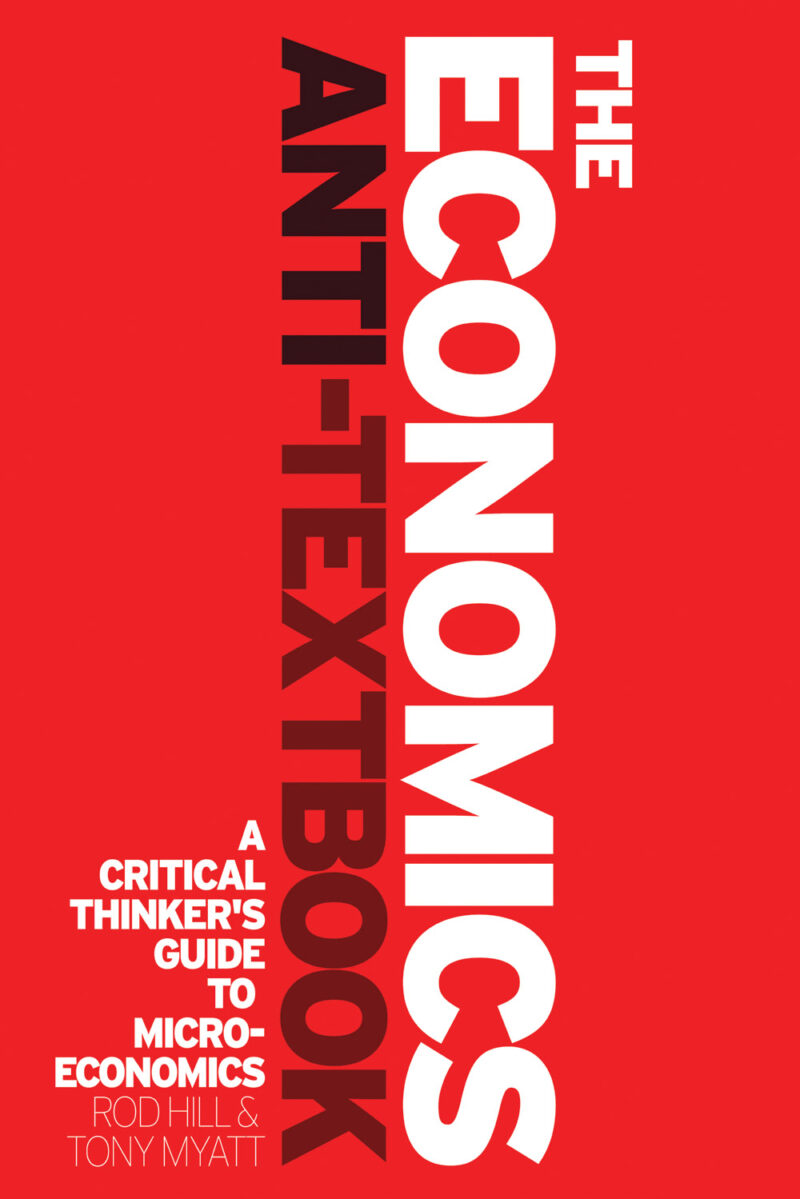
The Economics Anti-Textbook
A Critical Thinker’s Guide to Microeconomics
Mainstream textbooks present economics as an objective science free from value judgments. The Anti-Textbook argues that this is a myth-one that is not only dangerously misleading but also bland and boring. Challenging the mainstream textbooks’ assumptions, arguments, models and evidence, this book puts the controversy and excitement back into economics to reveal a fascinating and a vibrant field of study-one which is more an ‘art of persuasion’ than it is a science. Paralleling a typical textbook, each chapter provides a brief synopsis of the topic at hand before presenting an analysis and critique. Drawing on the work of leading economists, the Anti-Textbook lays bare the blind spots in the texts and their sins of omission and commission by demonstrating the hidden value judgments and lack of evidence, as well as the silencing of contrary evidence and alternative theories.
About the book
Mainstream textbooks present economics as an objective science free from value judgments. The Anti-Textbook argues that this is a myth-one that is not only dangerously misleading but also bland and boring. Challenging the mainstream textbooks’ assumptions, arguments, models and evidence, this book puts the controversy and excitement back into economics to reveal a fascinating and a vibrant field of study-one which is more an ‘art of persuasion’ than it is a science. Paralleling a typical textbook, each chapter provides a brief synopsis of the topic at hand before presenting an analysis and critique. Drawing on the work of leading economists, the Anti-Textbook lays bare the blind spots in the texts and their sins of omission and commission by demonstrating the hidden value judgments and lack of evidence, as well as the silencing of contrary evidence and alternative theories.
Contents
- : Preface: Why an ‘anti-textbook’?
- : Economics: where you start influences where you go
- : Building models and testing them-officially and unofficially
- : How markets work (in an imaginary world)
- : People as consumers-while ignoring power and social context
- : The firm, production and costs: theory versus reality
- : Market structure and efficiency-or why perfect competition is not so perfect after all
- : Externalities and public goods: the ubiquity of market failure
- : The marginal productivity theory of income distribution-or you’re worth what you can get
- : Government, taxation and the redistribution of income: is a just society just too expensive?
- : Free trade and globalization without the rose-tinted glasses
- : Self-defence against textbook ideology: a summing up