
Born Sacred - Book Review
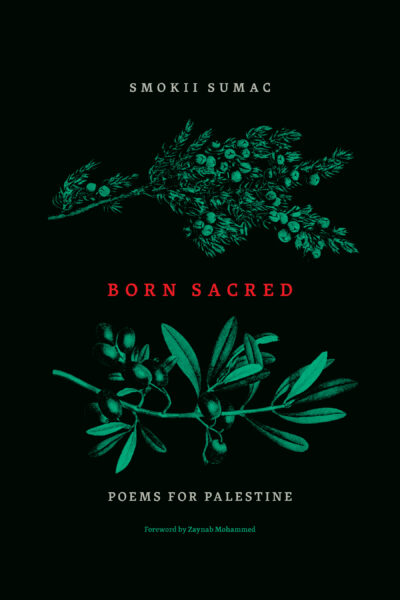
Born Sacred
Poems for Palestine
“today
my body is in pain”
The opening lines of poetry in Smokii Sumac’s Born Sacred: Poems for Palestine succinctly introduce the themes of the book: its ritualistic daily rhythm of poems-as-prayers, the embodied empathy of the poet, and the violence that pervades the lives of colonised people. Globally speaking, Indigenous identity is a political response to colonial relations, a provisionally embraced collective identification that acknowledges the structural relationship between local and culturally-specific struggles for sovereignty and the global networks of extractivist capitalism, harnessing the power of solidarity for anti-colonial politics. Perhaps the most famous example of this cross-cultural solidarity in Native American/First Nations history is the funding sent by Choctaw and Cherokee people to Ireland in 1847 during the potato famine (Shrout 2015). That early example of Native North Americans recognising those colonised by England as sharing Indigeneity was followed by others in an ongoing politics of recognition that gained power throughout the twentieth century — and which continues into the twenty-first (Rennard 2021).
The creative and critical connections made repeatedly between Native North America and Palestine since the British government published the Balfour Declaration in 1917 extend and expand that genealogy. In one recent and particularly well-known example, the Arab American National Museum’s 2016 exhibition The Map is Not the Territory brought together thirty-nine artists whose work examined commonalities and relationships between Native American, Palestinian, and Irish subjects of settler colonialism (Heath and Painter 2016). Reading Smokii Sumac’s newest collection of a hundred poems for Palestine, we accompany the author as he confronts these parallels almost in real time. With breathtaking honesty, Sumac reveals his initial ignorance about, and emerging knowledge of, the structural—and sometimes material—relationship between the Israeli occupation of Gaza and his own Ktunaxa experience of settler colonialism in Canada.
Sumac’s learning experience is clearly informed by his queerness—a subject position that he explored directly in his first collection, you are enough: love poems for the end of the world (2018), and which is now nuanced by its inflection with cross-cultural empathy. Queer identities, like colonial ones, are produced in relation: expressions of queerness are a reflection of, reaction to, and resistance against a policing of gender and sexuality intended to maintain social and economic structures rooted in reproductive heteropatriarchy. In precolonial Indigenous spaces that did not ascribe to that ideology, queerness looked different—but it still existed, in the sense that in any social order there will be people who blur, cross, combine, exceed, transgress, or simply refuse the categories of behaviour and belonging they are offered. At its heart, queerness is a scepticism about categories—albeit often a playful one—that only escapes the pitfalls of individualism through queer people’s recognition of queerness itself as a common experience. The poems in Born Sacred reveal that, for Sumac, as for so many queer Indigenous poets before him, colonized queer experience is precarious, joyful, frightening, exhausting, ceremonial, loving, profound, and dangerous. In all of these things, he finds it is analogous to the Palestinian experience in Gaza.
At the same time, throughout the collection Sumac acknowledges the incommensurability of his experience and those in an active war zone. Sometimes these admissions are explicit, as in “19”: “i tell my therapist / yes we survived genocide / but not like that / / active / war / zone / / my therapist / reminds me / comparison / doesnt make sense / in this context” (44). Others are more oblique, as in “25”: “i think of writing some / comparison / / yesterday i forgot the / shopping list at home / and in Palestine / / Osama / writes his name / on his hand / / to be remembered / / to be remembered” (56). As this suggests, there are echoes and repetitions throughout the hundred poems that almost give them the formal character of a single epic poem. True to that genre, Born Sacred tracks the agonistic journey of an individual through unfamiliar landscapes. In Sumac’s case, the journey is emotional and intellectual, and one by one the poems reveal a vulnerable and
occasionally painful story.
As you would expect from such a project, there is a productive unevenness to the individual poems, which range from tensely crafted to unabashedly emotional. At their best, they are both: while the poems in this volume are not consistently great, they are never, to borrow a word from literary critic Seth Perlow, bad. In his condemnation of bad Instagram poetry, Perlow rejects the “cliché, trite notions, and cloying sentiments” that pervade the genre as “lack[ing] any sense of literary invention” (Perlow 2025, 250). To be clear, he is writing about a genre of poetry to which Sumac does not aspire: a commercialised and commercially successful exploitation of a platform designed to reward content that appeals to the broadest spectrum of consumers—not just readers—possible. Whereas the Instapoets attracting Perlow’s derision actively pursue generic sentimentality and have over a million followers, Sumac has just over four and a half thousand, and in between his poems he eschews sponsored posts in favour of quiet celebrations of personal milestones and professional joys.
At the same time, he revels in the specific formal qualities of Instagram as a poetry platform that literally shapes and frames the words it presents. The interrelation of form and content is a defining characteristic of poetry and in an important sense, the poems on the printed pages of Born Sacred are remediated texts. In his original medium, Sumac plays consciously with the aesthetics of individual posts and the distinctive Instagram grid, sometimes carefully alternating frames containing white text on black ground (or the inverse) with photographs of trees, rivers, loved ones, and other relatives. In this aesthetic sense, he is very much an Instapoet, gently making fun of himself in comments like, “I posted too early but it'll mess up my grid view if I delete it and repost” (8 August 2020). In this way and other, more serious ones, Sumac intentionally builds community as well as a following online.
Throughout Born Sacred the poems acknowledge and document online interactions that lead to learning, empathy, and growth. In a very real sense, the comments that accrete around each posted poem or image, and the intertextuality, intentional and otherwise, of Sumac’s own posts and the platform as a whole, are a vital to the work’s significance. The book’s origin on a social media platform structures the logic of Born Sacred, which posits poetry as a political act of witnessing. To witness is to document the present moment as it happens; where another writer might take weeks or months to craft a poem, Sumac has chosen the obligation of writing quickly. In this sense, he actively transforms the commercial premise of the platform into a political tool, using the aesthetic power of accumulation to render his poetry an act of accountability. Those interested in Sumac’s project would do well to follow the poet on Instagram as well as buying this collection in book form.
— Transmotion (Vol. 11, No. 1), Louise Siddons, University of Southampton, April 2026