
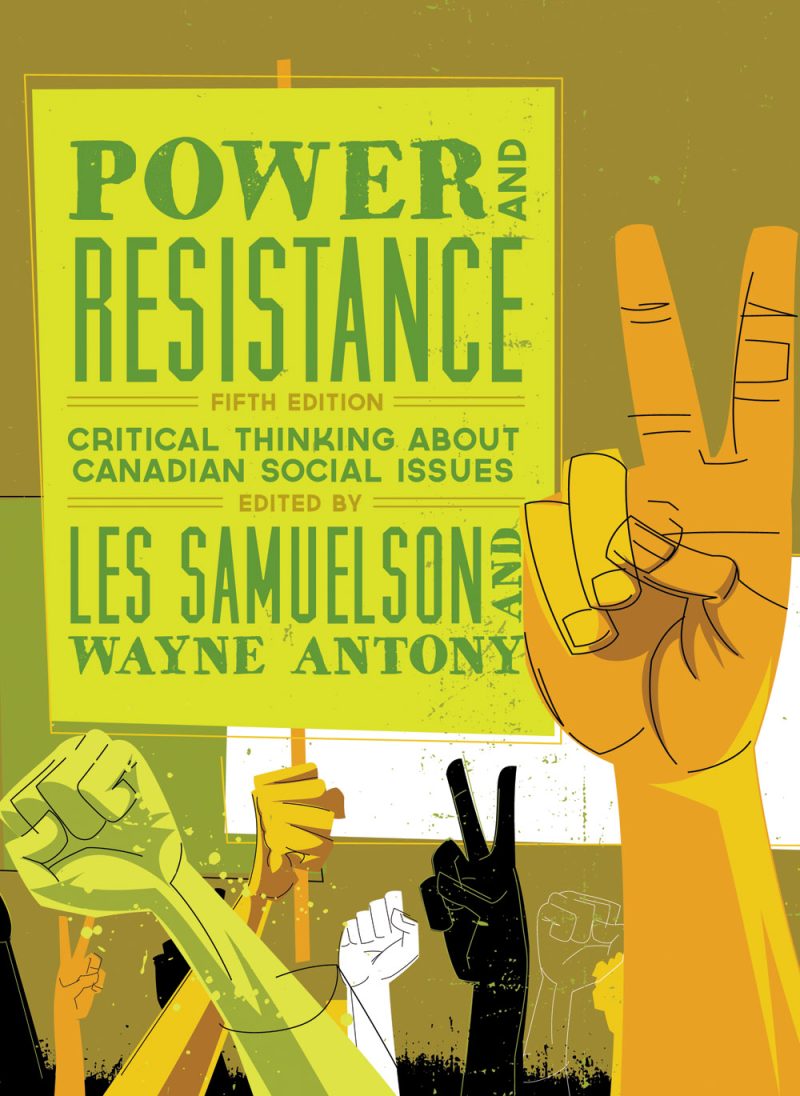
Power and Resistance, 5th ed.
Critical Thinking about Canadian Social Issues
How do we make sense of the social problems such as poverty, economic collapse, violence, homophobia and pollution that continue to plague Canadian society? From the neoliberal perspective all of these issues come down to individual choice and action, but from the critical perspective social issues emerge from inequalities – disparities in access to housing, education, healthcare and wealth, for example – and inequalities emerge from relations of power. Some groups of people have privileged access to resources and use their power to maintain and enhance their privilege, thereby creating problems for other groups of people. In Power and Resistance contributors use a variety of analytical approaches within this critical perspective to explore specific social, economic and political issues that result from social inequality. The essays in this collection also examine the ways that Canadians, both individually and collectively, resist these inequalities in order to resolve social troubles and create a more just society.
This edition has been replaced by Power and Resistance, 6th ed.
About the book
How do we make sense of the social problems such as poverty, economic collapse, violence, homophobia and pollution that continue to plague Canadian society? From the neoliberal perspective all of these issues come down to individual choice and action, but from the critical perspective social issues emerge from inequalities – disparities in access to housing, education, healthcare and wealth, for example – and inequalities emerge from relations of power. Some groups of people have privileged access to resources and use their power to maintain and enhance their privilege, thereby creating problems for other groups of people. In Power and Resistance contributors use a variety of analytical approaches within this critical perspective to explore specific social, economic and political issues that result from social inequality. The essays in this collection also examine the ways that Canadians, both individually and collectively, resist these inequalities in order to resolve social troubles and create a more just society.
Suitable for a variety of social science disciplines, this accessible textbook uses case studies drawn from the Canadian experience to introduce students to complex notions of social and structural inequality, power and resistance. This 5th edition of Power and Resistance includes many of the familiar chapters but also adds new ones dealing with homophobia in high schools, body art, the global economic crisis, social media, fat-phobia, food politics and the tar sands.
What people are saying
Gleema Nambiar, Sociology, Dawson College“I’ve used Power and Resistance consistently over ten years in my Social Problems classes with great success. Each (chapter), being of academic calibre, not only introduces scholarly writing style to college students, but most importantly, covers a wide range of burning issues through the (variety of) critical perspectives.”
Dennis Pilon, Political Science, York University“Power and Resistance is a great resource for teaching. I have used it for a variety of courses at different levels of study. It combines theoretical rigour with an empirical enquiry over a broad range of topics relevant to Canadian politics and society. In an accessible and engaging style, the book models how to do effective social justice scholarship, and why we need more of it.”
Contents
- : Social Problems and Social Power (Wayne Antony & Les Samuelson)
- : The State and Social Issues: Theoretical Considerations (Murray Knuttila)
- : Invisibilizing Violence against Women (Ruth Mann)
- : “Homophobia High”: Sexual and Gender Minorities in Canadian Schools (Tracey Peter & Catherine Taylor)
- : Persistent Poverty in Canada (Jim Silver)
- : Global Slump: Power, Resistance and the Capitalist Crisis (David McNally)
- : “We Were Not the Savages”: Indian Residential Schools (Daniel Paul)
- : Keeping Canada White: Immigration Enforcement in Canada (Wendy Chan)
- : Fat Phobia and the Politics of Sexuality (Marianne Parsons)
- : Resisting Conformity: Women Talk about Tattoos (Jessica Antony)
- : It Begins with Food: Social Change and the Politics of Food (Sally Miller)
- : Ecology, Climate Change and the Politics of Sustainability: The Case of the Alberta Tar Sands (Debra Davidson & Mike Gismondi)
- : Social Media and Social Justice Activism (Leslie Regan Shade & Normand Landry)
- : Privatization Is Not the Cure: Health Care “Reform” in Canada (Pat Armstrong)
- : Private Interests at Public Expense: Transforming Higher Education in Canada (Claire Polster)
- : Crime as a Social Issue (Les Samuelson)
- : Index