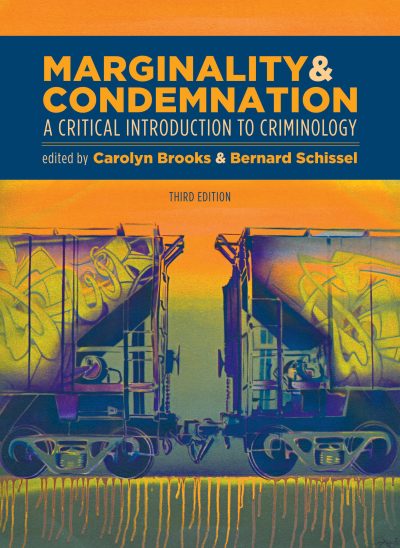

Marginality and Condemnation, 2nd Edition
An Introduction to Criminology
This second edition of Marginality and Condemnation continues the approach of the first edition: it sees crime as a socio-political process. What is defined as criminal, how we respond to “crime” and why individuals behave in anti-social ways are the consequences of and reproduce social inequalities. While this book argues that the marginalized in society are most likely to feel the full force of criminal (in)justice, it does address the full range of criminological analysis.
This edition has been replaced by Marginality and Condemnation, 3rd Edition
About the book
This second edition of Marginality and Condemnation continues the approach of the first edition: it sees crime as a socio-political process. What is defined as criminal, how we respond to “crime” and why individuals behave in anti-social ways are the consequences of and reproduce social inequalities. While this book argues that the marginalized in society are most likely to feel the full force of criminal (in)justice, it does address the full range of criminological analysis.
Marginality and Condemnation also embodies an alternative pedagogy. It begins with an overview of criminological discourse, mainstream approaches and new directions in criminological theory. General issues for understanding crime are outlined by the editors at the beginning of each section of the book. Detailed and specific empirical chapters follow, offering windows onto general issues in criminology, ranging from the historical and current nature of crime and criminal justice to responses to criminality. Readers are encouraged and challenged to understand the crime process through concrete analysis rather than abstract approaches.
In addition to extensive updating, this second edition adds new chapters on pluralist theory, the sex issue in criminological discourse, official statistics, street crime and the politics of defining crime.
Praise for the first edition: “Marginality and Condemnation …Part One: is a comprehensive and accessible introduction to critical criminology … it shows students how to use the theories to understand and explain a number of crime and justice issues. This book is an excellent resource for … teaching … a critical criminology perspective.”–Dawn Anderson, University of Regina, co-author of Manufacturing Guilt: Wrongful Convictions in Canada
What people are saying
Dawn Anderson, University of Regina, co-author of Manufacturing Guilt: Wrongful Convictions in CanadaPraise for the first edition: “Marginality and Condemnation …Part One: is a comprehensive and accessible introduction to critical criminology … it shows students how to use the theories to understand and explain a number of crime and justice issues. This book is an excellent resource for … teaching … a critical criminology perspective.”
Authors

Contents
- : Part One: Explaining Crime: Theoretical Approaches—Consensus Criminology: The Limits of Orthodox Theories of Crime (Bernard Schissel)
- : The Emergence of Pluralist Theories in Criminology (Lauren Eisler)
- : Critical Criminology: Rejecting Short Term Solutions to “Crime” (Carolyn Brooks)
- : The Sex Question in Criminology (Elizabeth Comack)
- : Part Two: The Public Construction of Crime: Misrepresentation or Reality?—Misrepresentation Race and Crime in the Toronto Print Media (Scott Wortley)
- : The Social Construction of “Dangerous” Girls and Women (Karlene Faith & Yasmin Jiwani)
- : Crime Statistics and the “Girl Problem” (Sandra Bell)
- : Part Three: The Historical Shape and Form of Crime—Aboriginal People and Social Control: The State, Law and “Policing” (Les Samuelson & Patricia Monture)
- : A Residential School Survivor’s Story (Helen Cote & Wendy Schissel)
- : A Criminal Justice History of Children and Youth in Canada: Taking Stock in the YCJA Era (Shahid Alvi)
- : Part Four: The Contemporary Shape and Form of Crime—“But They’re Not Real Criminals”: Downsizing Corporate Crime (Laureen Snider)
- : Welfare Fraudsters and Tax Evaders: The State’s Selective Invocation of Criminality (Janet Mosher)
- : Crime-Making on the Street: A Critical Perspective (Willem De Lint & Christian Pasiak)
- : Aren’t Women Violent, Too? The Gendered Nature of Violence (Elizabeth Comack, Vanessa Chopyk & Linda Wood)
- : Part Five: The Contemporary Shape and Form of Punishment—The Politics of Imprisonment (Carolyn Brooks)
- : “Armed and Dangerous”/“Known to Police”: Racializing Suspects (Carl James)
- : Women in Prison in Canada (Helen Boritch)
- : Doing Time (Donald Morin)
- : Part Six: Changing Responses to Crime—The Application of Criminological Theory to Contemporary “Crime” Issues (Carolyn Brooks & Bernard Schissel)
- : Restorative Justice, Inequality and Social Change (Rob White)
- : A Letter from Saskatoon Youth Court (Kearney Healey)
- : Index